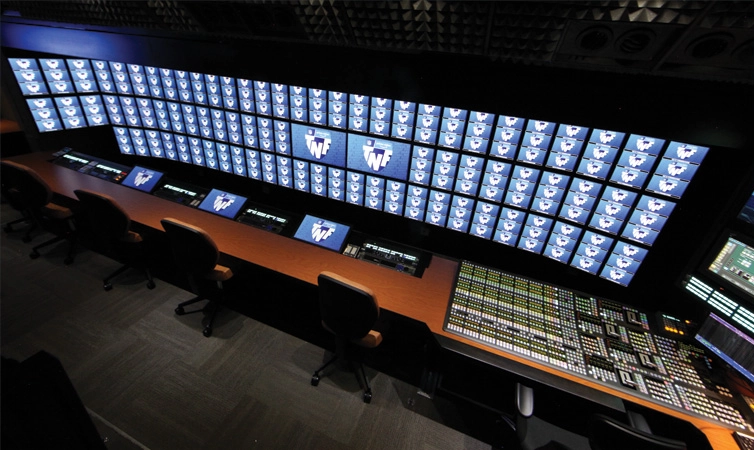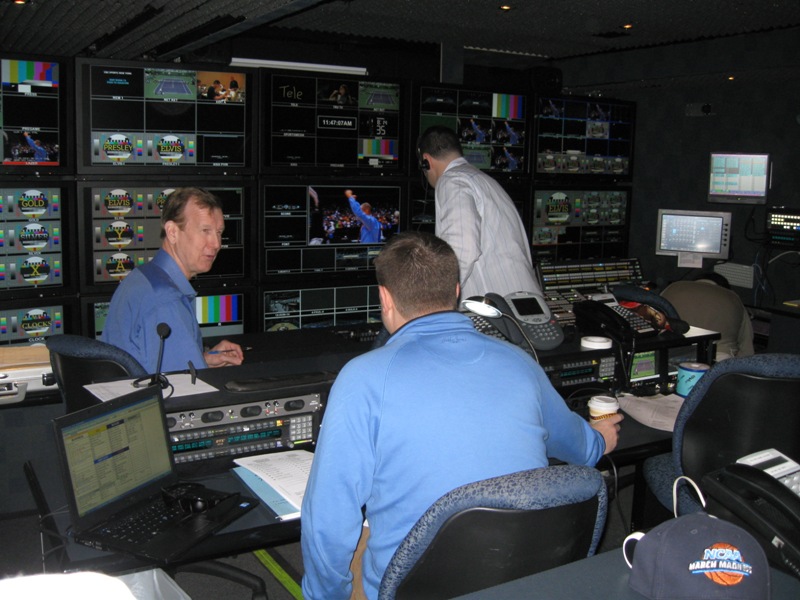
Arguably the most state-of-the-art set of mobile units ever built: Amazon's Prime One and Prime Two native-IP from Game Creek Video. Not only is it the largest production gallery in a mobile unit, but it also features the largest monitor wall in a truck (10 three-monitor columns of Boland 32.5 OLED monitors.
Professional Broadcast Monitors vs Consumer Displays: Why Accuracy Matters in Broadcast Workflows
In the realm of broadcast and video production, the choice of display technology is crucial for ensuring content fidelity and quality. Professional broadcast monitors and consumer displays serve distinctly different purposes. While consumer displays are designed for general entertainment purposes, broadcast monitors are engineered to meet the high standards demanded by media professionals. Understanding the benefits of these professional tools is essential for anyone involved in broadcast workflows.
Color Accuracy: A Key Differentiator
One of the primary differences between professional broadcast monitors and consumer displays is color accuracy. Professional monitors are calibrated to provide precise color reproduction, which is vital in post-production tasks such as color grading and editing. Unlike consumer-grade televisions, which often enhance colors for aesthetic appeal, broadcast monitors maintain color fidelity to ensure that the final output looks exactly as intended. This accuracy becomes particularly important in industries where visual storytelling is critical, and any deviation in color can compromise the integrity of the content being broadcast.
Build Quality and Reliability
Another key aspect of professional broadcast monitors is their superior build quality and reliability. These monitors are designed with robust components to withstand prolonged usage and varying environmental conditions typically encountered in professional settings. According to 360 Research Reports, 62% of broadcast monitor units are used for studio applications, while 38% serve field applications. This versatility highlights the demanding environments that professional monitors are built to handle, ensuring that they maintain performance consistency whether in a controlled studio environment or in the field where conditions are less predictable.
Resolution and Image Detail
Resolution and image detail are also critical features where broadcast monitors outperform consumer displays. High-end broadcast monitors usually support resolutions higher than standard consumer products, providing the clarity necessary to spot subtle imperfections during editing. For instance, in film and television production, the ability to discern small details can make the difference in achieving the seamless visual continuity that audiences expect. The superior resolution provided by professional displays ensures that editors and colorists can work with the finest levels of detail to perfect their craft.
Connectivity and Customization Options
Professional broadcast monitors also offer extensive connectivity and customization options that are lacking in consumer displays. They often include advanced input and output configurations, which are critical for interfacing with multiple sources and ensuring optimal workflow integration. Additionally, these monitors provide users with configuration settings tailored for specific studio or field applications, further enhancing their adaptability to various production needs. Without these options, even well-captured footage can lose its quality during the post-production process due to inadequate monitor support.
The choice between professional broadcast monitors and consumer displays should be informed by the intended application within the broadcasting workflow. Accuracy in color reproduction, build quality, resolution, and connectivity all play critical roles in determining the suitability of a monitor for professional use. While consumer displays may suffice for general viewing, only professional-grade monitors can meet the rigorous demands of broadcast and video production. Investing in the right technology ensures not just visual consistency but also the integrity and quality of the final product, making accuracy a pivotal factor in choosing the right display solution.
Related Posts